Monday, July 2, 2018

Winnipeg Folk Festival 2018


 This year's theme for the Prairie Outdoor Exhibition at the Winnipeg Folk Festival is tradition.  Inspired by  Manitoba's provincial flower and campers summer tradition of pitching a tent my installation is called the Crocus Tent. Using donated fabrics and yarn, an old bicycle wheel and various poles this crocus leans down petals tied creating a shady patch.  Festival goers are welcome to drop by and sit a spell  in the shady patch,  while at night the tent will light up providing a brightly lit haven.


 You can find more information about the project and other artists involved in the Prairie Outdoor Exhibition this year at this site:
https://www.winnipegfolkfestival.ca/2018-prairie-outdoor-exhibition/

Friday, August 11, 2017

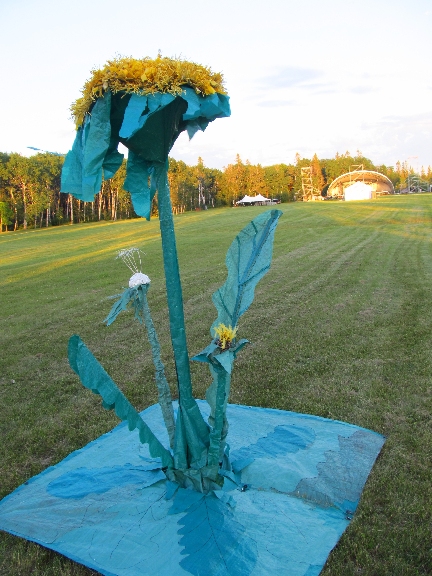
Winnipeg Folk Festival 2017 Dandy Dandelion installation


From start

My helpers


To Finish


Many thanks go out to Tim Turner and Bernice Turner my helpers for set up and thanks to the Winnipeg Folk Festival for supporting local artists.


Alternate sources:
https://www.instagram.com/p/BWRSejOAqvb/?taken-by=teddysims007

Photo by Meghan Bedford.


Monday, June 19, 2017

Coming in up 2017


I am preparing a new sculpture for the 2017 Winnipeg Folk Festival. Above is a preview photo showing my assistants working on the piece. You can find more information about the project and other artists involved in the Prairie Outdoor Exhibition this year at this site http://winnipegfolkfestival.ca/folk-fest/festival-info/prairie-outdoor-exhibition/

I also have two pieces currently on display at the Cre8ery in the Winnipeg Exchange District at 125 Adelaide.  Link is here http://www.cre8ery.com/

Best wishes to all for a fabulous summer!

Thursday, March 24, 2016

The link below leads to National Geographic and an article about the Human Condition and our impact upon the plant.  One fact listed on the page that leaps out for me is the factoid listed about Puento Hills Landfill, Whittier California which is listed as the largest landfill in the US. At this landfill gas is collected from decomposing garbage generating roughly 40 watts of energy each day which is sold to a local power company.  Closed in 2014 this landfill no longer accepts garbage but what forward thinking to put garbage to use.  I wonder how many years this landfill will continue to produce methane?

http://www.nationalgeographic.com/earthpulse/human-impact.html

This link is for the landfill:
http://www.lacsd.org/solidwaste/swpp/energyrecovery/landfillgastoenergy/puentehillsgastoenergy.asp

Thursday, April 30, 2015

Lacey Mew

Here is a preview of progress on my latest project.  Of course it includes a little bit of needle lace.  I am continuing to explore traditional needle lace techniques while researching other materials in relation to it.


Tentatively titled "Lacey Mew."   While lacey is obvious, the word mew has many meanings among them is an old English meaning that relates to a cage for hawks, as well as a place of concealment.

Monday, February 16, 2015

Myung Urso


Myung Urso is a South Korean artist with several degrees including an MFA in fibre arts.  Her style of combining unusual materials to make jewelry is fascinating.  Wood, fabric, yarn, paper, gesso, and wire are just some of the materials that Myung uses making works more sculptural than jewelry.  I admire this artists daring in combining materials together with a jewelers skill while employing the rawness of fibres.

http://www.myungurso.com/work.html

Monday, September 15, 2014

Ernesto Neto

The artwork of Ernesto Neto is tactile and curious.

http://www.designboom.com/contemporary/neto.


Thursday, August 7, 2014

Upcoming exhibits

A touring exhibition titled Hats from a Life Lived includes one of my fibre pieces titled Creative Hands.  This exhibit features many wonderful women artists from Winnipeg and is curated by artist Colette Balcaen. The show is scheduled to be in Neepawa and Portage La Prairie for August and September 2014

Hats from a Life Lived

In Neepawa at the Viscount Art Gallery. An opening event is scheduled for August 13, 2014 from 1-4 pm. The exhibit will remain in Neepawa until the end of of August. 
You can see more about the show and the centre here: neepawavcc.ca

The entire exhibit then moves to Portage La Prairie to the Portage and District Arts Centre.  It will remain on display from September 2 - 27, 2014. 
 For more information about the arts centre see:
 www.portageartscentre.ca

This project was fun as the curator Winnipeg artist Colette Balcaen invited artists to participate in a project of altering vintage hats to represent subjects and people who were of influence in our lives.  My hat was influenced by three women in my life who inspire me to make things.  My mother, my grandmother and my mother-in-law.  Each image illustrates their favourite creative pastime.


I chose needle lace as the method of creating the images and then went about the process of learning how to make needle lace as I had never tried it before.  Needle lace is a form of lace making that allows you to create a fairly detailed image using just thread and a needle.


I started by drawing an image on a piece of paper and then couching a thicker piece of crochet thread onto the paper to act as an outline.  Once this is done then smaller thread is used to basically create a decorative grid of thread lines and stitches to fill in the image. I even took some liberties in creating my own stitches from the more traditional. Then the entire thread image is lifted off of the paper by cutting the couching threads and gently clipping them away from the finished project.  Each image was then tacked onto the hat.  I am very pleased with the overall look.

Friday, August 1, 2014

The Secrets of the Snow Queen: An Eco Tale

I have illustrated my first publication!  Titled The Secrets of the Snow Queen, An Eco Tale written by Ruth Asher. This Eco Tale invites the reader into a fairy tale setting, including an evil queen, a captured child, a quest, talking animals, even a goofy gargoyle. At its heart, however, is a contemporary issue about living harmoniously with plants that supply us with food, animals at risk, and one another.  Big kids and little kids might enjoy receiving a copy of The Secrets of the Snow Queen.


The book is available for purchase at McNally Robinson and online at amazon.com as an ebook.

Oil Painting Methods

Oil painting methods have not really changed much in over 100 years. A quote  from “The Painters Methods and Materials” 1926. 
“In the first place it (oil) changes in refractive index with age.  This begins from the moment the oil paint, painted out in a thin layer has begun to dry.  The dry paint is already not so opaque, not so brilliant, as the paint squeezed out of the tube.  This change goes on slowly but remorselessly through the years, though, of course, at a diminishing rate.  We know that the slow chemical changes which take place in the linseed oil film are not complete after four hundred years,  that the film is still improving in toughness and insolubility. ……..The pigments then are growing deeper in tone and more translucent, and hence it is that we have pentimenti, the under-paintings ultimately showing through.”
This is the beauty of oil paint, that as it ages the colours become more transparent and richer in tone.  The aging process allows light to shine through the layers of colour into the painting in effect blending the layers of colour together.  Even heavy impasto will change over time deepening in tone and developing an oil laden gleam that catches the light and emphasizes the presence of texture in the painting.  This will remain throughout the life of the painting and in fact improve as the painting ages. 

One of my favourite quotes by Ted Godwin in The Studio Handbook for Working Artists: A Survival Manual.


"An acrylic painting will never look as good as the day you finished painting it, however an oil painting will never look as bad as the day you finished painting it.”


Industry, oil on canvas, 2010: Private Collection

Painterly Challenge

Why not paint with acrylics instead of oils?  Acrylics have several advantages.  They are water soluble and there are lots of mediums available that can help make acrylic paint imitate oils.  Moreover there are mediums that can allow an artist to paint with thick heavy impasto with very low risk of cracking as it dries and enables an artist to paint quickly as acrylics dry very fast.
Oil paint on the other hand can be tricky.  You are required to paint in layers allowing each to dry as you proceed.  The use of underpainting white, thinner, and wingel expedites this process by speeding drying time.  However you are still required to allow for drying time before putting one colour over another or you risk making a muddy mess of your colours.  Just to make it even more challenging as a painting dries oil will rise to the surface making it difficult for the next layer of paints to bind to the surface.  If you use too much oil mixed in with pigment you can lower the tone of the colour or impede the paints ability to bind while not enough oil will do the same.  The ready availability of colours in tubes along with various mediums take much of the guess work out of oil painting but knowing when to stop painting is important to a successful painting


Interrogate Space, Oil on canvas, 2009: Private Collection

Saturday, June 14, 2014

Machine Knitting

I am enjoying using an old Bond Machine knitter that was a gift from my mom.
Its a bit finicky to use but the results are quite nice. This machine is called the Incredible Sweater Machine identified by the fact that the needle bed is in two parts.  Its first incarnation was the Bond Original which came out in 1981.  The inventor Roger Curry named the machine after Bond Street in London apparently because he felt that street in particular illustrated the height of British fashion at the time. Curry wanted to make it possible for all women to make their own fashionable garments quickly and easily.


For some reason my machine does not have the original carriage with it.  I am using the intarsia key plate to knit with until such a time that I find a proper carriage.


Using the keyplate makes setting up the hooks a bit tedious as they are set up by hand using cards to position them as shown in the first picture.  The yellow card for working position and green card places the stitches into the far front of the needle bed.


There are tons of youtube videos and instructional websites out there as machine knitting is still popular. This is a good website for information about the Bond machine.
 http://www.bond-america.com/help/help_usm_faq.html

Sunday, March 9, 2014

The Jar


The things people throw away become part of a microcosm growing and/or decaying, being consumed and consuming. Each piece of detritus is the seed of change an evolutionary chink in our planet. The full potential of these plantings has yet to be realized. There is a cosmology of destruction and growth contained within an environment encapsulated. The glass jar will never decompose but the metal lid slowly oxidizes rusting away as chunks fall into and around. Once the air penetrates the semi-opaque contents are warmed by the sun slowly turning the jelly yellow-brown, releasing the unctuous aroma of petroleum within. In 50 years the soft pvc lining on the underside of the lid begins to decay perhaps cracking becoming brittle, taking over 450 years to breakdown. The glass jar may at some point be crushed melding container and contents with the mulch of rotted wood, leaves and dirt. Various bugs, seeds, plantlife unfortunate enough to fall into the jar become encased in the petroleum become part of the soup of jelly crushed glass, plastic and mulch.

Painterly Challenge

Every once in a while I do a painting that just does not want to be painted. 
At the outset of this painting I carefully planned my landscape, drawing it out in charcoal and planning where the colours would go.  I then executed an underpainting blocking some of the basic forms and the darker areas using raw umber and some lighter shades of the colours I wanted to fiinish the painting with.  The palette for this painting lime green,  red orange, chcolate brown and ceruleian blue.  I let the underpainting dry.   Then I started brushing thin coats of colour mixed with linseed oil.  Intent upon building the layers as I paint; fat over lean, light to dark to get the full effect of layering oils and to bring out the light through the colours.  A half an hour of concentrating intently as I paint and the drool starts to form at the corner of my mouth.  Next thing I am leaning back in my chair, brush in hand, head back, mouth open with snores softly issuing.
I awake abruptly feeling refreshed.  I chuckle as I realize that once again I am trying to subvert my nature as a painter.  I love to paint but usually with heavy impasto.  I love the texture of paint mixed to the consistancy of butter and then slathered onto the canvas.  The very fact that I fell asleep while doing my own painting, well its kind of sad, but simply demonstrates that I was bored out of my skull.


A painters style is something developed over time, most often over years of work. I believe that it is marked by what the artist finds most exciting about painting mixed at times with a little dose of luck. Whether an artist paints realistic, impressionistic, abstract, expressionist etc., the primary requirement to developing your skill is to paint and to keep on painting but paint what interests you.

Saturday, April 13, 2013

The Best View


The best view can come from visiting the past or in this case sites laden with the past.  Seeing something old like this can give a fresh perspective.  What we leave behind becomes embedded in the landscape.  It becomes part of the landscape around us.


|

Thursday, March 14, 2013

Ordinariness and Inspiration


I took a snap as we were passing by mostly because something about the features drew my eye. The dull grey sky flattens the light and the ethereal quality of this image is enhanced by drawn and heavy clouds suspended over twin humps of forest in the distance. Railway lines, phone and hydro lines trace the boundaries of wilderness and act as familiar markers delineating the flatness of prairie.

Robert Kroetsch writes in Seed Catalogue of the indelible imagery of the Canadian landscape. His prairies are spare dry and dusty boned; the seeds of growth and the patterns of prairie life are unearthed touching upon a place that dominates as it nurtures. His poetry recalls the plainness of the prairies much like the place in this photograph. To me Kroetsch's poems drum a message of Canadian prairie and prairie living that inspires a host of familiar memories and images from the countryside I grew up in.  When you look at something that is so familiar its familiarity makes it ordinary you have to make an effort to appreciate the beauty.  To really see what makes a place remarkable you need to recognize its power, its ability to unite us and invoke a sense of the sacred.  This is what inspires me to paint.

Tuesday, February 12, 2013

Toe Challenged

Have you ever bought a pair of socks and after wearing them the first time found that the seam on the toe made the socks unbearably uncomfortable to wear?

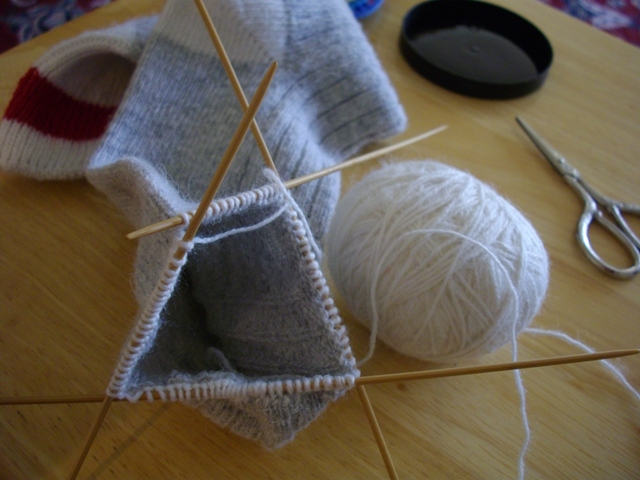
I am always on the lookout for wool socks, that are well made, light and hopefully comfortable on the tootsies but occasionally I get suckered.  Like with the last six pack of socks I bought for my husband.  After the first wear they were pronounced unfit for duty.  That's eight whole dollars wasted.  I ask myself, should I throw them away or give them to a second hand store?  No! No way will I waste these socks instead I will attempt to re-knit the toe in a make work project that will involve hours of my time and energy.

I started in the kitchen cutting the toe off, had a nice light snack to bolster my energy and then moved to the living room. 

Comfortably ensconced in my couch I could deal with pulling the yarn back to the line of gray yarn indicating the beginning of the toe.  As I pull back the yarn individual stitches are revealed making it easier for the next part.


After a good stiff drink I began picking up the stitches all around the sock toe.  I don't remember how many there were but its important to pick up every stitch and to ensure that all strands are neatly over the needles.  I used 0 mm bamboo needles which are perfect for picking up the loops.  This process gave me plenty of time to consider factory knit socks. They can be terrific because they are made with very fine materials and very closely woven making them comfortable and sturdy.  Added value comes from not having to make them yourself.  However factory knit socks are often sewn shut along the toe leaving a bulky and uncomfortable seam leaving me, and my husband in this case, bitter and foot sore.


Once all your stiches are picked up the rest is a breeze!  Pick a lightweight, wool sock yarn for finishing the toe and knit it like you would a regular toe.  I like to decrease four stiches every row until I have around 22 stitches left then I will knit two together all around until I have around 5 stiches left which I draw up onto a loop.


Here are several finished socks.  They have been enthusiastically worn many times since I finished fixing them.  No more sore tootsies.   We just won't talk about how long it took to fix.  I can't say its rational, but making or even re-making things is good for the soul.

Monday, January 28, 2013

God, I Love Goats!


The handsome cat pictured above is our Ross enjoying the great outdoors.  We live in the country and spend a fair bit of time gardening and growing our own food. I love every minute of this rewarding lifestyle.   Even so I can't escape a nagging yearning for chickens, maybe a goat would be nice, or a cute sheep or two to mow the lawn.; its enticing this idea. 

So You (Don't Particularly) Want to Be a Farmer (click here for article)  is an article that runs along the same lines a bit long but definately well worth the read. When I started reading the article I realized how much I actualy do have a hankering to be a farmer or "the farm brain worms"  as the writer puts it. I really appreciated the author's brevity and sense of humour.

My parents moved out to a small hobby farm when I was a teenager.  I went through my high school years taking the school bus, chasing ducks and chickens and picking up eggs, and plucking the occasional chicken.  I don't remember any of the real responsibilites of raising chickens and ducks just that they got into everything and chickens really are quite stupid and ducks don't mind the occasional cuddle.  I would be game to give it a try someday; when my hubby isn't looking, a little chicken house will pop up in the back yard. or Maybe next time I reach across the table to my loved one, my words of endearment will echo this farming disease with " God, I love goats."

Thursday, January 24, 2013

Railway Ties as Fenceposts


I have driven by this fence a number of times and each time I consider the effort it would take to plant these ties into the ground.  I know because I spent a summer moving railway ties while making a flower bed.  Each tie weighs upwards of 100lbs, and in this case they are planted in a mile long stretch. No barbed wire is laced between posts to tie them together and as a result they crumble, faint and wend askew the entire length of the fence.